Fabric buildings foundations must support the full structural load, resist wind and snow forces, and comply with local building codes. The right choice depends on four key factors: soil conditions, building size, intended use, and permanence. The 7 most common foundation types for fabric structures are: strip footing, deep foundation, concrete slab, concrete block, grade beam, concrete pier, and concrete beam (longrines).
Key Factors That Determine Your Foundation Choice
When planning a tension fabric structure, one of the most important decisions you’ll make is choosing the right foundation. Fabric buildings foundations are not one-size-fits-all, their performance, durability, and cost-efficiency depend largely on the foundation system you select.
Selecting the right foundation is not just a structural decision, it’s also a strategic one. The foundation supports the entire weight and tension of the structure and plays a key role in wind and snow load resistance. It must also meet local building codes and adapt to your operational environment.
Let’s explore the most common fabric buildings foundations types and applications in greater detail.
Temporary vs. Permanent Fabric Building Foundations
Temporary Fabric Buildings Foundations
Temporary foundations are engineered for speed and flexibility. When your operation requires a fabric building that can be relocated, expanded, or decommissioned, a temporary foundation system keeps your options open without compromising structural performance.
These systems require minimal ground disturbance, making them the preferred choice for environmentally sensitive sites, remote locations, and projects with evolving spatial needs. Installation is straightforward and requires less specialized labor, which translates directly to lower upfront costs.
Best for: Seasonal agricultural storage, construction staging areas, remote industrial operations, and any project where future relocation is a possibility.
Permanent Fabric Buildings Foundations
Permanent foundations are built for the long term. They deliver the highest level of structural stability and are designed to meet full building code requirements for load-bearing, wind resistance, and frost depth; making them the right choice when your fabric building is a fixed, mission-critical asset.
At MegaDome, every permanent foundation is engineered to your specific site conditions, building series, and intended use. Whether you’re building a salt storage dome, an aircraft hangar, a fertilizer facility, or a recycling center, our in-house engineering team ensures your foundation performs for decades without compromise.
Best for: Industrial facilities, municipal infrastructure, permanent agricultural buildings, aviation hangars, and bulk material storage.
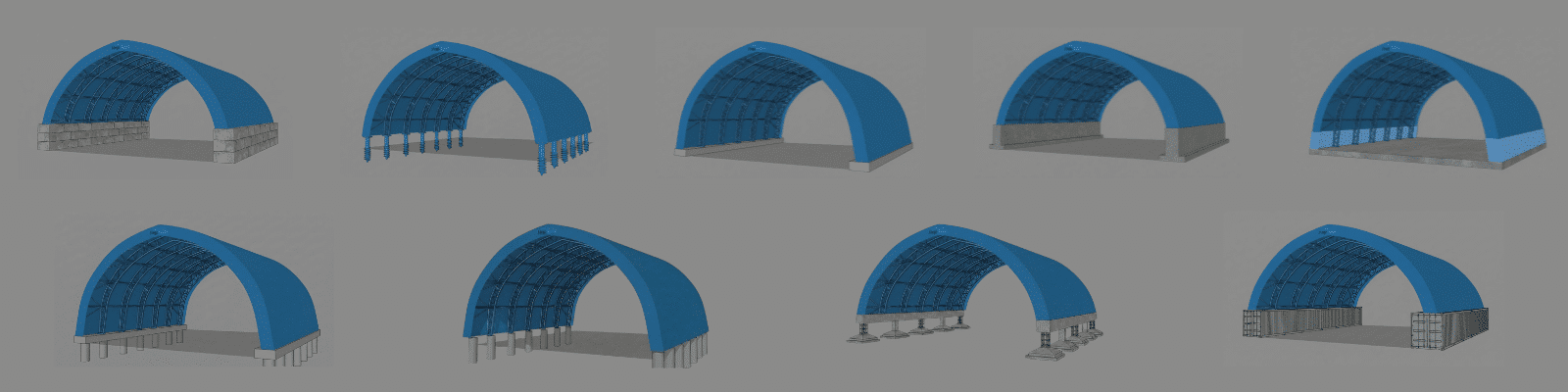
The 9 Types of Fabric Buildings Foundations
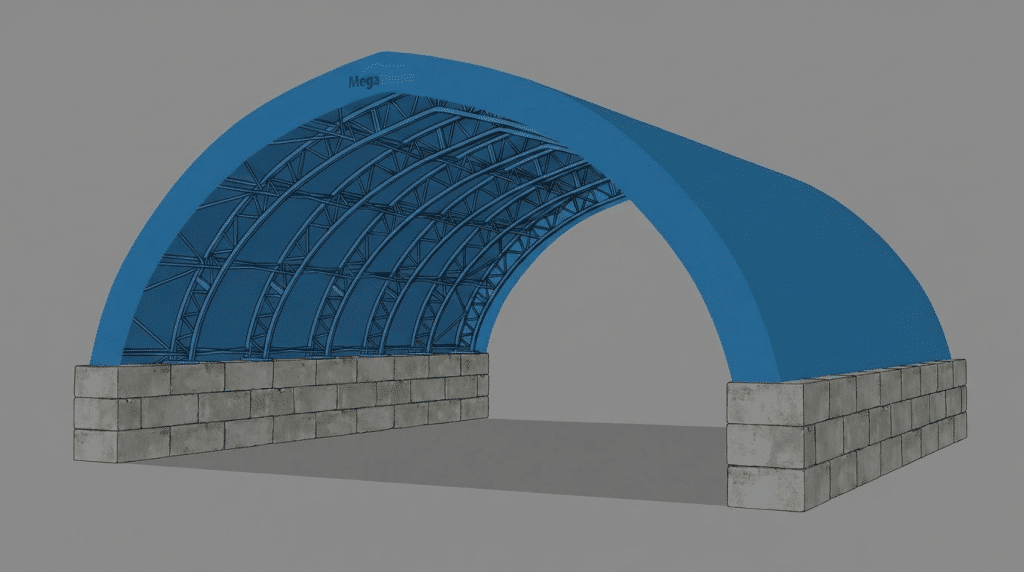
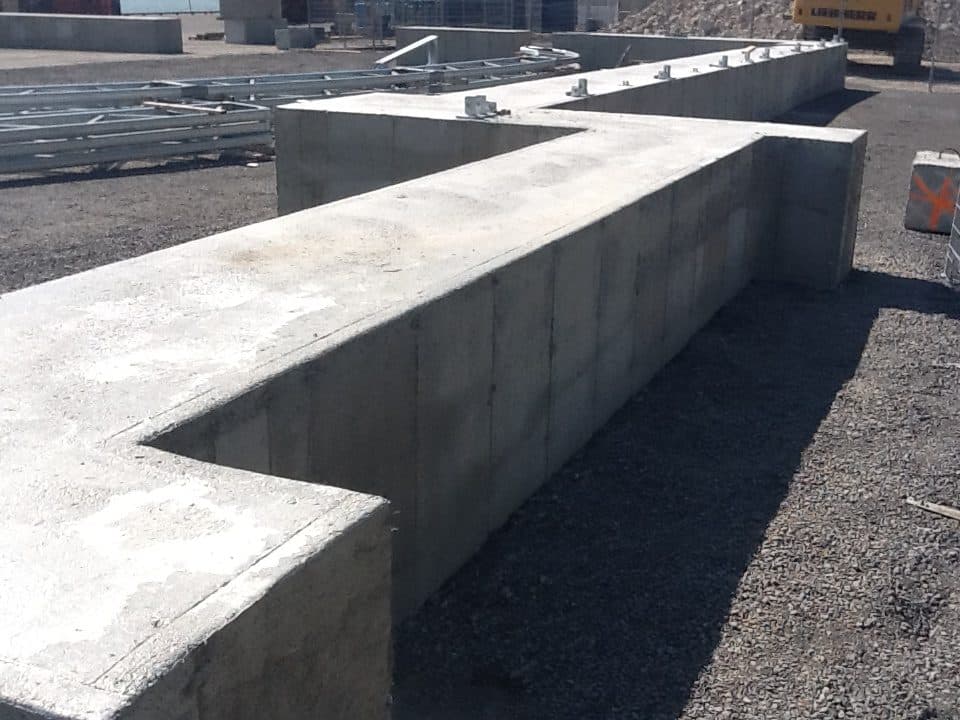
1. Concrete Blocks Foundation
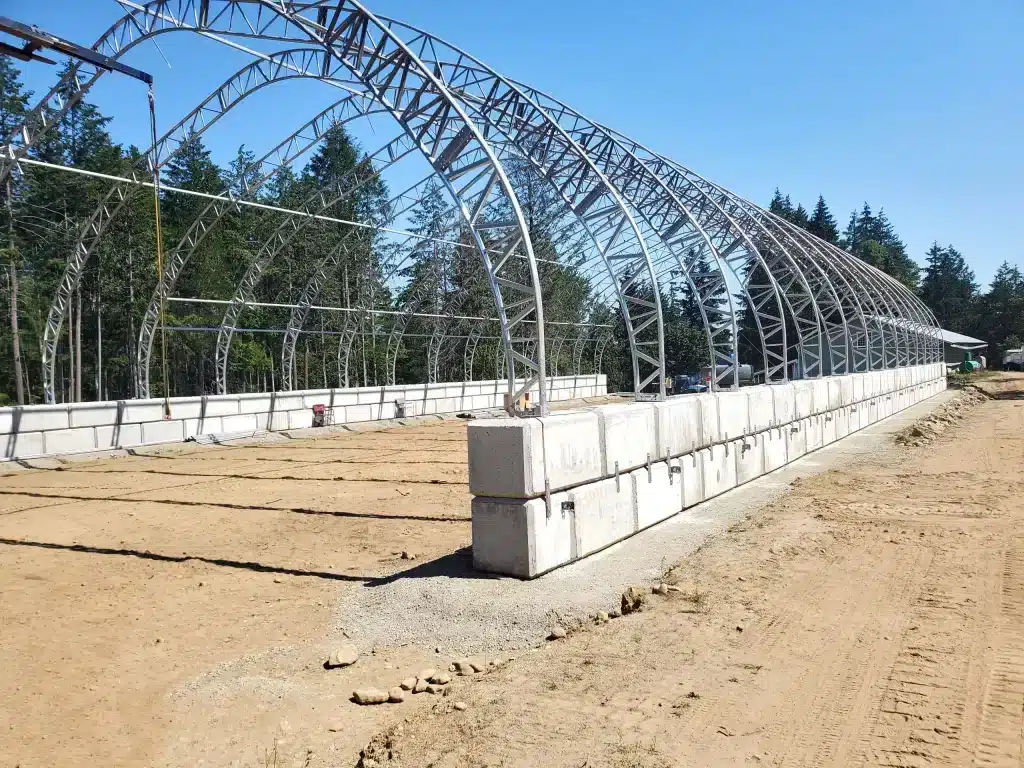
Concrete blocks are one of the most popular options. They provide excellent stability and height clearance for bulk storage or machinery access. Blocks can be precast or poured on-site and are ideal for temporary or permanent installations. Their modular nature also makes them well-suited for operations that may require future relocation or expansion.
Best for: Agricultural storage, sand and salt bunkers, composting, waste transfer facilities.
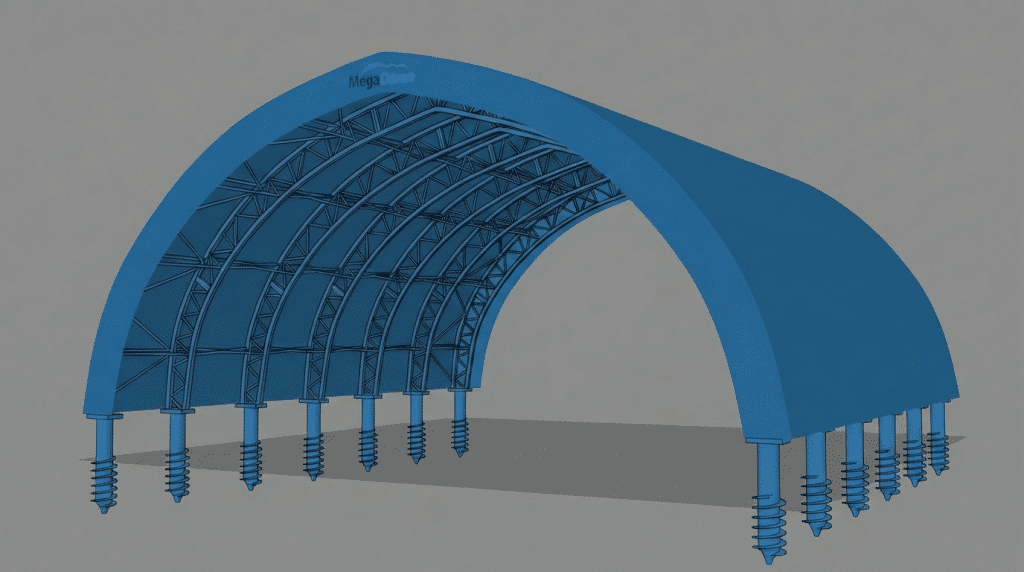
2. Helical/Screw Pile Foundation
Helical screw piles are a deep foundation option increasingly used for fabric buildings on challenging or unstable soils. Steel shafts with helical bearing plates are mechanically driven into the ground using hydraulic equipment, transferring the structural load from the building frame down to stable soil layers; without the need for excavation or poured concrete.
This foundation type is particularly well-suited for sites with expansive soils, fill areas, high water tables, or locations where frost heave is a concern. Installation is fast, clean, and produces minimal site disturbance, making it a practical choice for both permanent and temporary applications.
Best for: Sites with poor or variable soil conditions, flood-prone areas, remote locations with limited equipment access, and projects requiring a fast-turnaround foundation with minimal environmental impact.
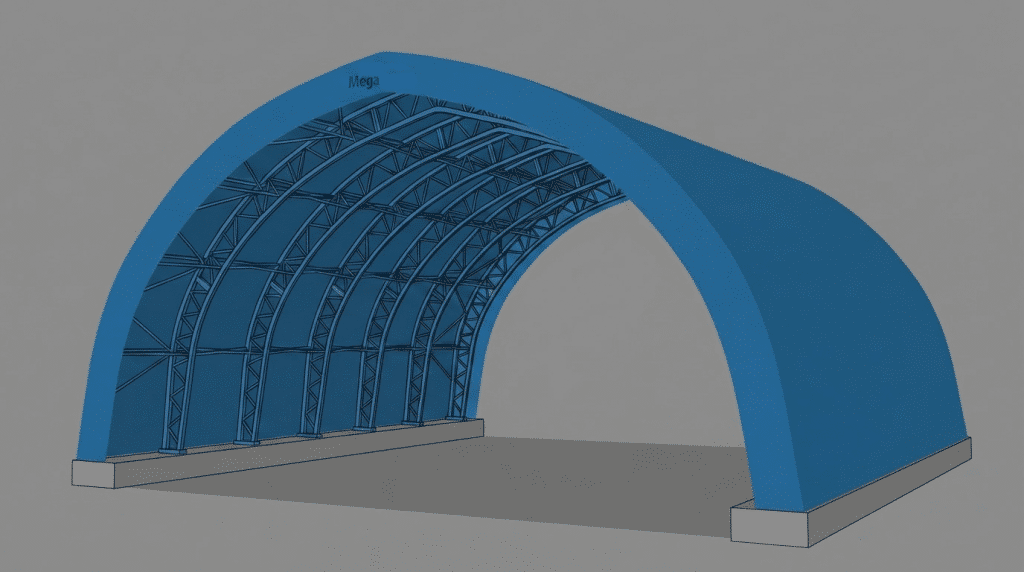
3. Strip Footing Foundation
This is one of the most common and economical fabric buildings foundations. It uses continuous concrete footings beneath the sidewalls to distribute the load across a broader area, making it ideal for compacted soil and lighter structures.
Best for: Temporary or seasonal agricultural structures, storage buildings, and workshops.
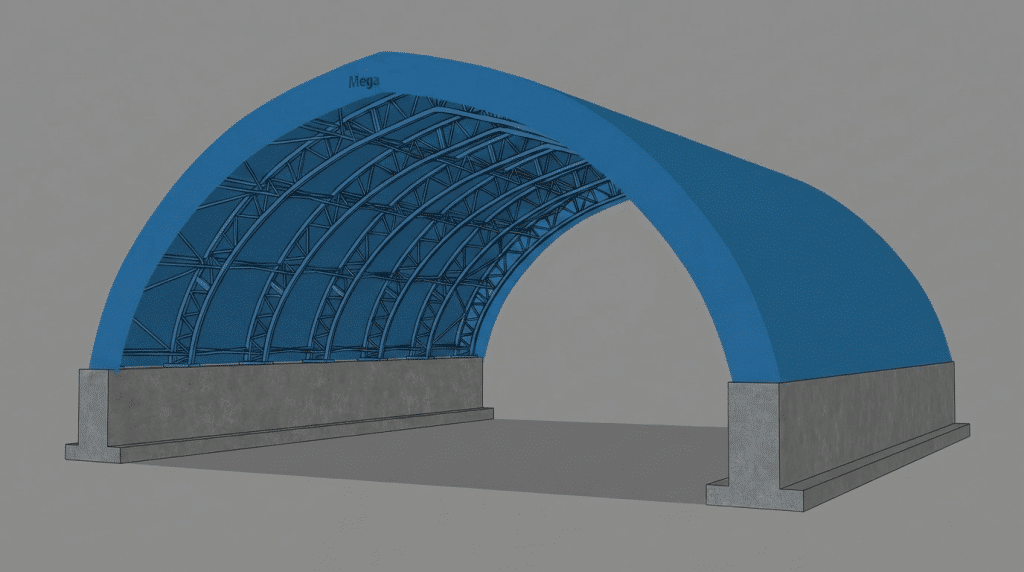
4. Poured Concrete Wall
Poured concrete walls are cast in place along the building’s perimeter, creating a rigid, reinforced base that handles both vertical loads and lateral forces from wind and fabric tension. Walls can be designed to various heights, allowing the building to be elevated above grade for improved drainage, loading access, or equipment clearance.
Best for: Permanent industrial facilities, salt and sand storage buildings, processing plants, and applications requiring elevated floor height or heavy perimeter loading.
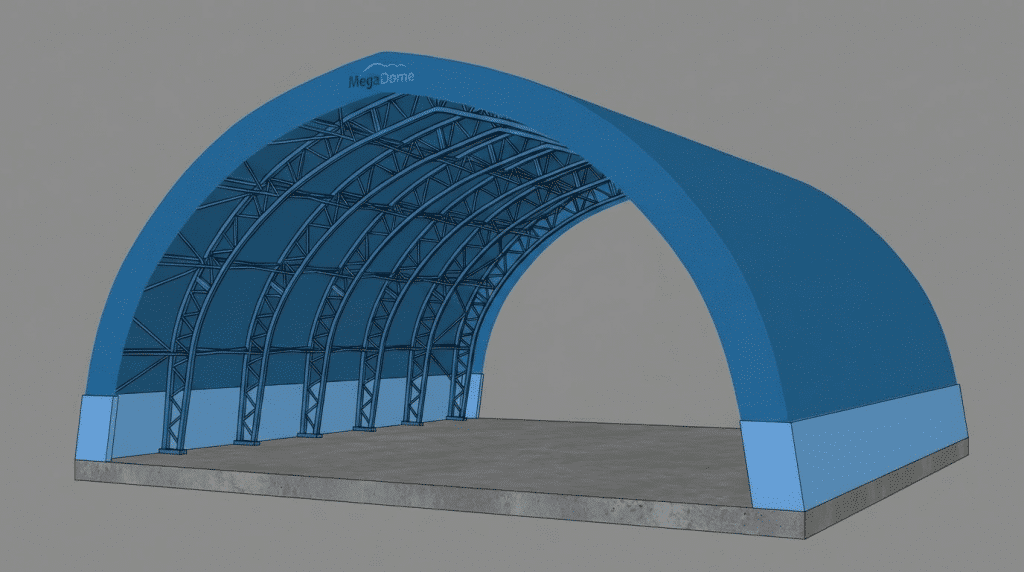
5. Concrete Slab Foundation
A poured concrete slab provides a clean, level surface ideal for equipment-heavy or people-centric applications. While it involves a larger upfront investment, it offers a strong, permanent solution that minimizes dust and simplifies interior maintenance.
Best for: Workshops, garages, aircraft hangars, processing facilities.
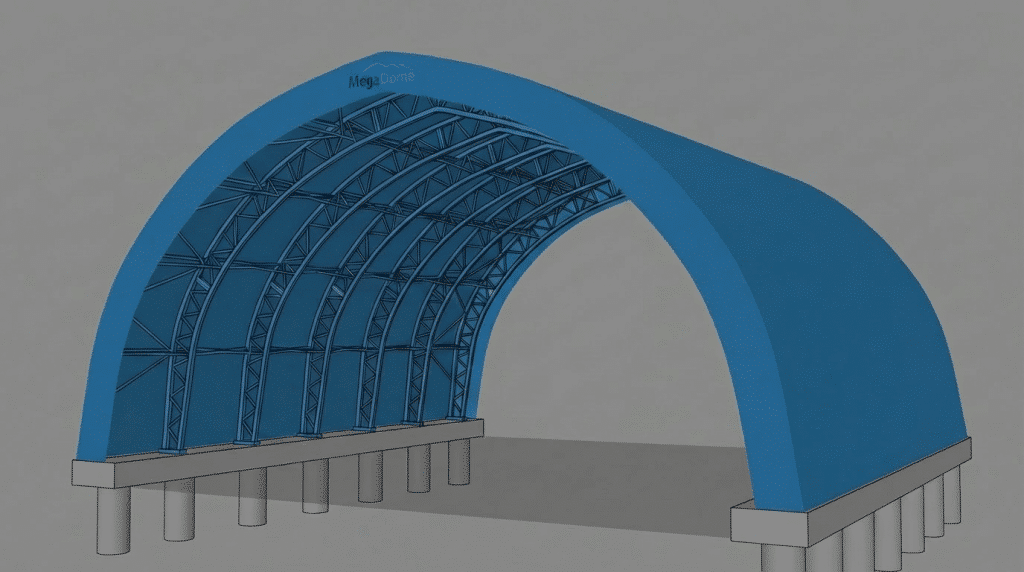
6. Grade Beam Foundation
Grade beams sit on the surface or shallow footings and link anchoring points, distributing structural loads evenly. A great middle ground between shallow and deep fabric buildings foundations.
Best for: Semi-permanent buildings in areas with stable soil.
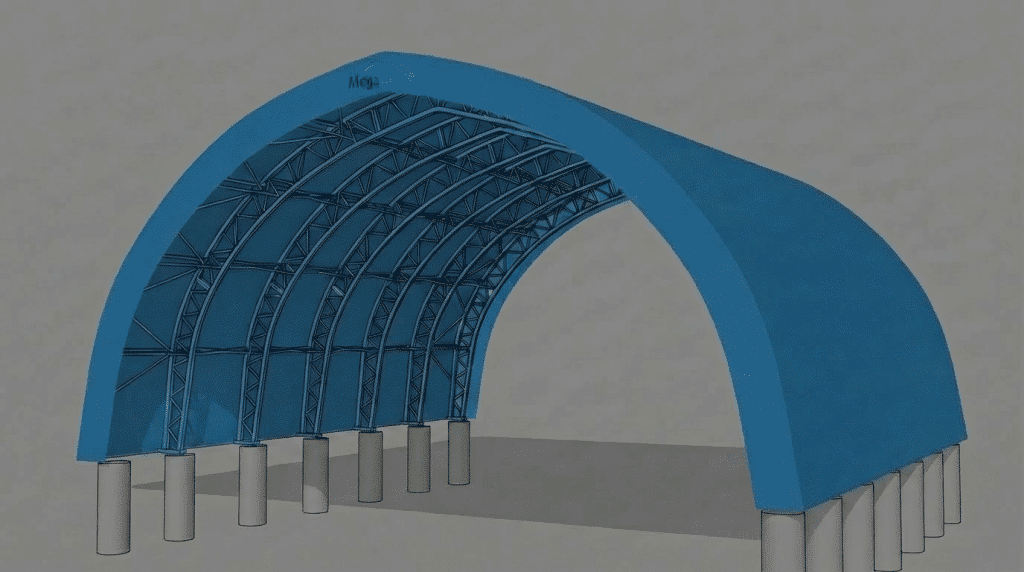
7. Round Concrete Pier Foundation
For applications that require flexibility and speed, fabric buildings can be mounted on steel rails or concrete piers. These options provide a cost-effective alternative to full fabric buildings foundations, especially for smaller or modular buildings.
Best for: Equipment storage, mobile operations, remote construction staging.
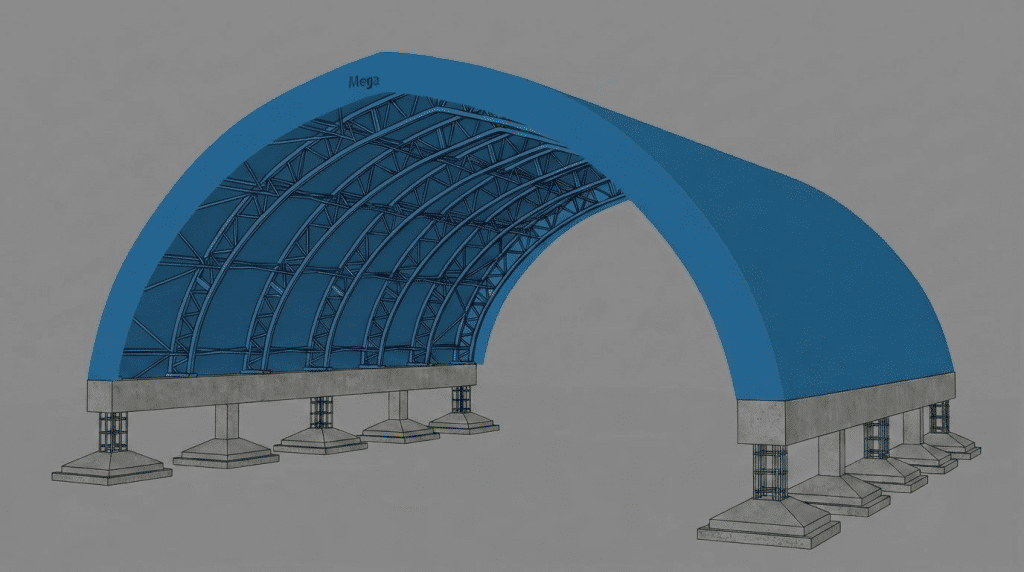
8. Concrete Beam Foundation
These horizontal beams rest on piers or soil to provide linear support and simplify the installation process. They are ideal for large modular fabric structures.
Best for: Industrial applications or variable ground conditions.
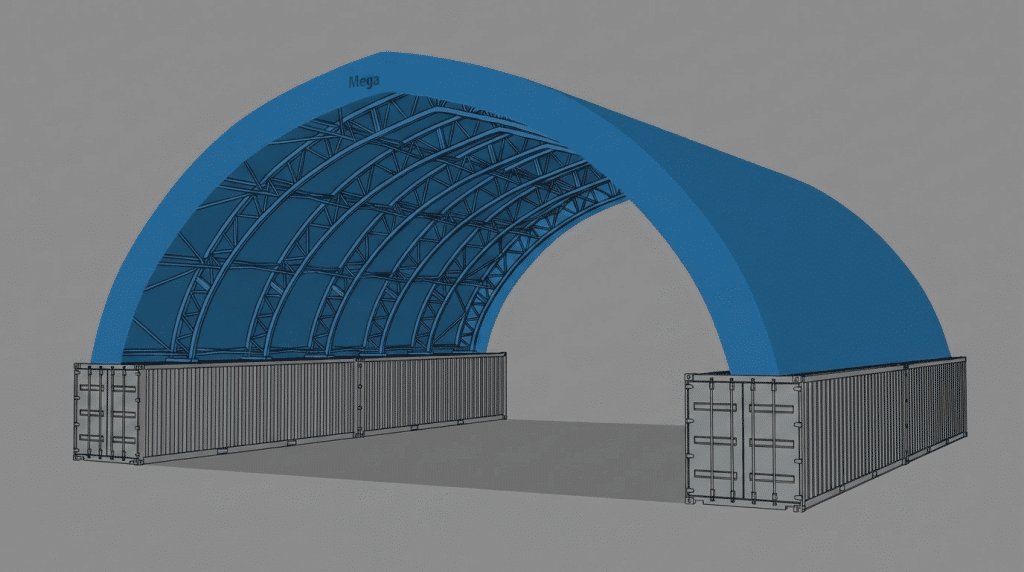
9. Shipping Container Foundation
Shipping containers offer a versatile and immediately deployable foundation solution for fabric buildings requiring additional clearance or integrated storage. By anchoring the building’s steel frame directly to one or two containers, this system adds 8 to 9 feet of usable height at the base; expanding interior volume without increasing the building’s footprint.
Beyond their structural role, the containers themselves remain fully functional as sealed, weatherproof storage space, completely protected from the elements and rodents. This dual-purpose characteristic makes shipping container foundations particularly cost-efficient on sites where secure ancillary storage is also a requirement.
Installation requires heavy lifting equipment but involves no excavation, no ground disturbance, and no poured concrete; making it a practical option for both permanent installations and projects where future relocation may be needed.
Best for: Remote sites, construction staging areas, operations requiring additional secure storage at grade, and projects where minimizing ground disturbance is a priority.
Site Conditions and Engineering Requirements
Soil composition, drainage, climate, and building load all influence the best choice of fabric buildings foundations. For example, heavy snow regions may require deeper footings, while flood-prone areas might benefit from elevated pier foundations. Every MegaDome project is reviewed by in-house engineers to ensure code compliance and long-term structural integrity.
Why the Right Foundation Matters
Investing in the proper fabric buildings foundations ensures structural integrity, protects your investment, and supports your building’s long-term performance. Whether you’re building for agricultural, commercial, or industrial use, MegaDome by Harnois offers engineered fabric buildings foundations tailored to your specific project needs.
Not sure which fabric buildings foundations is right for you?
Contact our team for a custom recommendation based on your site, structure type, and usage goals.
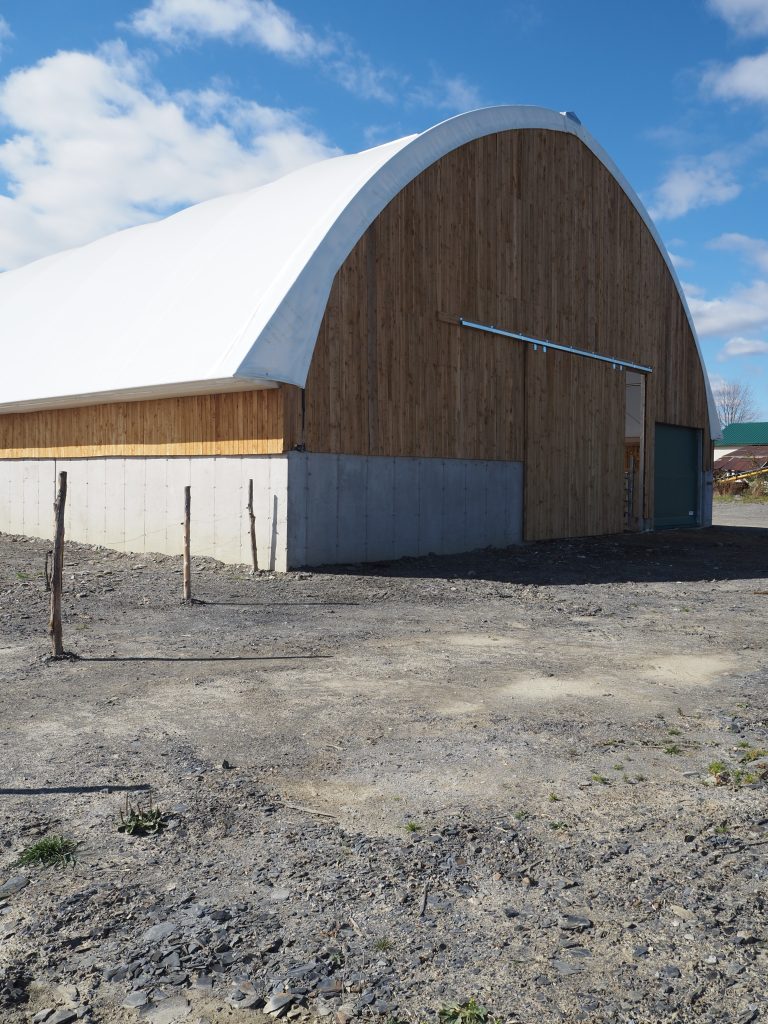
With their engineered steel truss frames, available in both peaked and arch profiles, and starting at just $15/sqft, MegaDome® Coverall Buildings provide a reliable, adaptable, and long-lasting solution for nearly any environment or operational need.
MegaDome® Coverall Buildings offer a unique combination of strength, flexibility, and efficiency, making them an excellent alternative to traditional structures. One of the most significant benefits is their cost-effectiveness, with average prices starting as low as $15 per square foot, fabric buildings provide large, functional spaces at a fraction of the cost of conventional construction.
These buildings are designed for rapid installation, allowing you to have a fully operational facility in weeks instead of months. Their modular design also allows for easy expansion, relocation, or reconfiguration as your needs evolve.
Another significant advantage is the natural light provided by the translucent fabric cladding. This reduces the need for artificial lighting, lowers energy costs, and creates a more comfortable and productive environment for both people and animals. Additionally, fabric buildings are naturally energy-efficient, often maintaining interior temperatures that are cooler in summer and warmer in winter, without relying on active climate control systems.
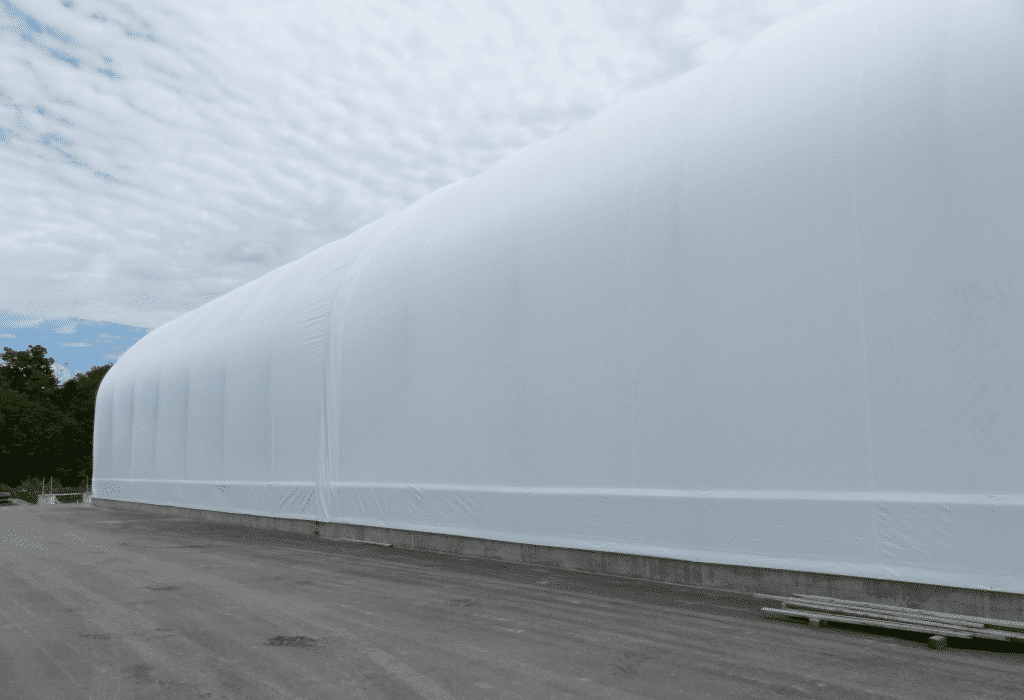
Whether you’re in agriculture, industry, or the public sector, fabric buildings offer long-term durability, low maintenance, and superior adaptability, making them an innovative and sustainable choice for a wide range of applications.
What Are MegaDome Fabric Buildings?
MegaDome Coverall Buildings are modern, cost-effective structures made with a steel truss frame and a durable, tensioned fabric membrane. They offer a flexible, long-lasting alternative to traditional wood or metal buildings and are ideal for agricultural, industrial, and municipal applications.
At MegaDome®, our fabric buildings are engineered and manufactured in Canada to handle even the harshest environments. Our steel truss frames, the backbone of every structure, are available in two roof profiles: a classic peaked roof or an elegant round profile. These options allow you to choose the shape that best fits your operational needs.
Key Features & Benefits:
- Available with peaked or arched steel truss frames
- Double truss
- Lower cost per square foot (starting at $15/sqft)
- 15-year structural warranty
- Customizable sizes and layouts
- Fast installation and easy relocation
- Naturally bright interiors with daylight-diffusing fabric
- Designed for durability and minimal maintenance
- 9 types of Fabric Buildings Foundations
Discover how MegaDome® Coverall Buildings deliver the strength of steel and the efficiency of fabric, engineered to perform, built to last.
Fabric Building Foundations Types FAQ
What foundation options are available for fabric buildings?
How do I choose the right foundation for my fabric building?
Can fabric buildings be installed on uneven or challenging terrain?
How long does fabric buildings foundations installation take?
- Portable systems, such as earth anchors or ballasted foundations, can typically be installed in 1 to 2 days.
- Helical piles are installed in 2 to 5days with minimal site disruption.
- Concrete foundations require 1 to 2 weeks, including excavation, pouring, and curing time.
