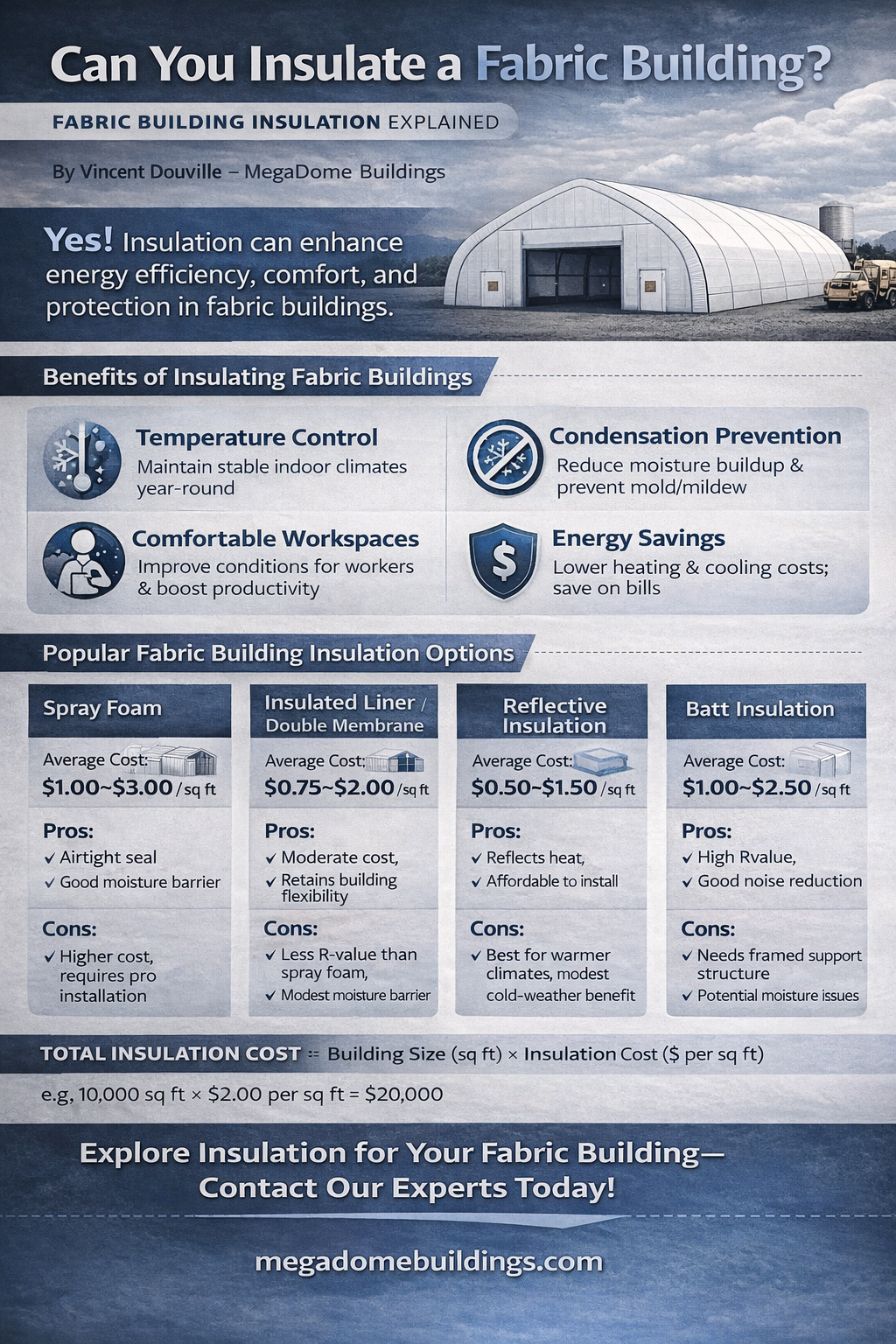
Can you insulate a fabric building? It’s one of the questions we hear most often, and the answer is a clear yes. Fabric building insulation is not only possible, it can transform your structure into a fully climate-controlled space suitable for year-round use. But doing it right means choosing the correct system, managing moisture, and understanding what Canadian building codes require for your specific application.
Why Choose Fabric Building Insulation?
Fabric buildings are already known for their versatility, affordability, and quick installation. For many applications, adding insulation takes those advantages further.
- Temperature control. In climates with extreme temperatures, fabric building insulation significantly stabilizes indoor conditions, reducing heating costs in winter and keeping the space cooler in summer.
- Condensation prevention. Insulation creates a thermal barrier between temperature zones. To work properly, it must be paired with a correctly positioned vapour barrier to prevent interstitial condensation, mould growth, and fastener failure.
Improved working environment. Insulated walls and roofs provide a more consistent, comfortable space for employees and occupants, improving productivity and morale.
Energy savings. Fabric building insulation reduces demand on HVAC systems, leading to substantial savings over time, especially in large structures where climate control is a major operating cost.
Building Code Requirements: What to Know Before You Insulate
⚠️ Important – Code Compliance
Agricultural buildings are generally exempt from the National Energy Code for Buildings (NECB). They remain subject to structural and fire safety requirements under the National Building Code, but no prescriptive thermal envelope requirements apply.
Commercial and industrial buildings are subject to the NECB 2020 and its provincial equivalents. In provinces where the 2020 edition is in force, new construction or additions started after the applicable transition date must meet updated requirements for opaque envelope U-values, insulation continuity, and thermal bridge mitigation. In Quebec, this applies to projects started after January 12, 2025.
Low-heating-demand buildings: Buildings with very low installed heating capacity (below the NECB threshold of approximately 10 W/m²) may be exempt from certain envelope requirements, but this threshold is extremely low. A single candle produces roughly 77 W of heat.
Our recommendation: Before proceeding with any insulated, heated fabric building project, consult a licensed Professional Engineer or building technologist and verify requirements with your local authority having jurisdiction (AHJ).
Fabric Building Insulation Options
The right insulation for a fabric building depends on climate, building use, budget, and applicable code requirements. Here are the four main options.
Spray Foam Insulation
R-value: approximately R-6 to R-7 per inch of thickness.
Pros: Excellent air sealing, strong thermal performance, conforms to irregular shapes and curved fabric profiles.
Cons: Higher upfront cost; must be installed by a qualified professional.
Important: Certain polyurethane spray foams have a high flame spread index. Building codes generally require exposed spray foam to be covered with an approved thermal barrier (gypsum board, cementitious coating, etc.) in occupied spaces. Never leave spray foam insulation exposed without fire protection in a heated fabric building.
Approximate cost: $1.00–$3.00 per square foot.
Insulated Liners or Double Membrane Systems
R-value: approximately R-6 to R-12 depending on thickness.
Pros: Maintains the building’s fabric flexibility, relatively low cost, well-suited for both new builds and retrofit applications.
Cons: Limited insulation performance compared to other options. Moisture management between membrane layers must be planned to prevent condensation buildup.
Approximate cost: $0.75–$2.00 per square foot.
Reflective Insulation
R-value: approximately R-3 to R-8 depending on air gap.
Pros: Affordable, lightweight, effective at reducing radiant heat gain.
Cons: Less effective in cold climates for limiting conductive heat loss. Generally insufficient on its own to meet code requirements for a heated fabric building in Canada.
Approximate cost: $0.50–$1.50 per square foot.
Batt Insulation
R-value: R-20 to R-40+, depending on thickness. For cold Canadian climates, R-30 is a commonly recommended starting point; R-40 or higher is available for maximum efficiency in the coldest environments.
Pros: Excellent thermal performance, well-suited for permanent insulated fabric buildings with secondary framing.
Cons: Requires a stable support structure. A vapour barrier on the warm side of the insulation is mandatory to prevent interstitial condensation, mould, and premature degradation, especially critical in cold Canadian climates.
Approximate cost: $1.00–$2.50 per square foot.
Advantages of an Insulated Fabric Building
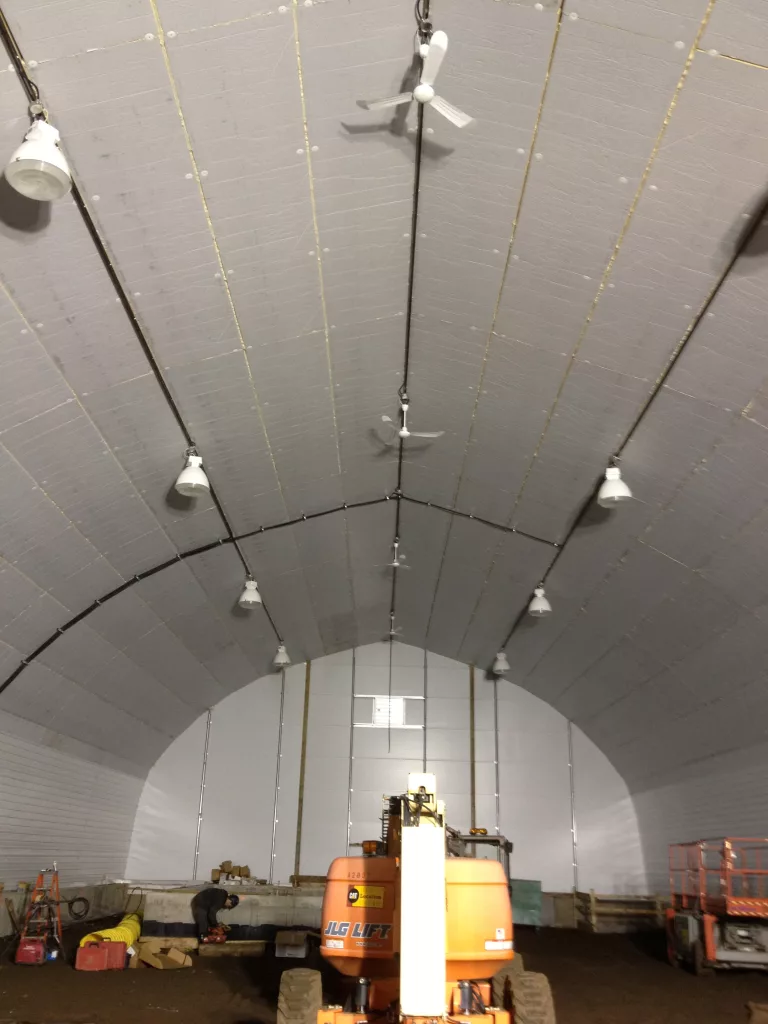
- Enhanced climate control. A properly insulated fabric building maintains consistent temperatures year-round, essential for agriculture, animal welfare, crop storage, cold-chain logistics, and sensitive industrial processes.
- Increased durability of stored goods. Stable interior conditions prevent warping, corrosion, and degradation of equipment and materials, reducing wear and extending their lifespan.
- Energy efficiency and cost savings. Reduced heating and cooling loads mean lower utility bills and less wear on HVAC systems, savings that are most significant in large structures.
- Sound insulation. Spray foam and batt insulation provide meaningful acoustic dampening, valuable for event spaces, livestock housing, and facilities near high-traffic or industrial areas.
- Condensation control. When paired with a vapour barrier and adequate ventilation, fabric building insulation significantly reduces moisture buildup, preventing mould and protecting structural integrity.
Fabric Building Insulation Cost
| Option | Approx. R-value | Approx. cost per sq. ft. |
|---|---|---|
| Reflective insulation | R-3 to R-8 | $0.50–$1.50 |
| Insulated liner / double membrane | R-6 to R-12 | $0.75–$2.00 |
| Batt insulation | R-20 to R-40+ | See note below |
| Spray foam | R-6 to R-7 per inch | $1.00–$3.00 |
For the first three options, multiply your building’s square footage by the cost per square foot to get a working estimate. For example, a 10,000 sq. ft. building with an insulated liner at $1.50/sq. ft. runs approximately $15,000 for insulation.
For batt insulation, budget approximately the same amount as your structure and fabric cover combined. If your dome structure and membrane come in at $15/sq. ft., expect batt insulation to add another $15/sq. ft. , a reliable rule of thumb when planning your total project budget.
Final Thoughts
Fabric building insulation is one of the most effective upgrades you can make to a fabric structure, turning a versatile, cost-effective building into a fully climate-controlled space suited for a wider range of applications. Done right, it means choosing the correct system for your use case, managing moisture with a proper vapour barrier, respecting fire safety requirements, and understanding what the building code demands.
Whether you’re storing temperature-sensitive materials, creating a comfortable workspace, or housing animals, our team can help you identify the right fabric building insulation approach, safely, durably, and to code.
Note: This article references Canadian building regulations. Requirements vary by province, territory, and authority having jurisdiction. Always verify applicable codes with a qualified professional before proceeding.
